


ISSUE1765


- Jean-Marie Pflomm, Pharm.D., Editor in Chief has disclosed no relevant financial relationships.
- Susan Daron, Pharm D., Associate Editor has disclosed no relevant financial relationships.
- Review the influenza vaccines available for the 2026-2027 season and discuss which vaccines are appropriate for specific patient populations.
- Discuss the risks and benefits of seasonal influenza vaccination.
- Annual vaccination against influenza is recommended in the US for everyone ≥6 months old without a contraindication.
- Vaccination should ideally be offered in September or October and continue to be offered as long as influenza viruses are circulating in the community.
- Vaccination reduces the incidence of laboratory-confirmed influenza and the risk of serious complications and death associated with influenza illness.
- Use of a high-dose (Fluzone High-Dose), adjuvanted (Fluad), recombinant (Flublok), or mRNA (mFLUSIVA) vaccine is preferred for adults ≥65 years old.
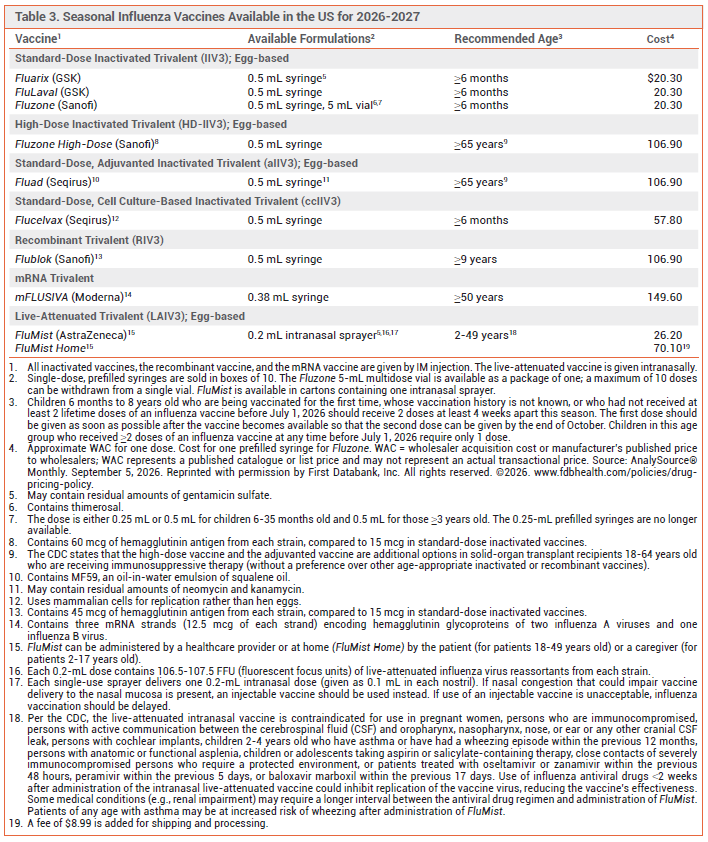
Annual influenza vaccination is recommended for all persons ≥6 months old without a contraindication.1-6 Influenza vaccines available this season in the US are listed in Table 3.
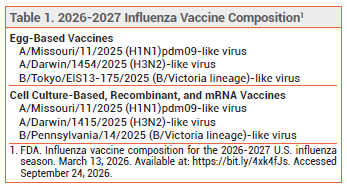
COMPOSITION — All influenza vaccines available in the US this season are trivalent: they contain two influenza A virus antigens and one influenza B virus antigen (see Table 1). Influenza A viruses are the primary cause of influenza-related morbidity and mortality, especially in older adults. Illness caused by influenza B viruses is usually more severe in children, especially those <5 years old.
TIMING — In the US, vaccination against influenza should ideally be offered in September or October and continue to be offered as long as influenza viruses are circulating in the community. In most adults, serum antibody levels peak 1-2 weeks after vaccination. Vaccination in July or August may result in suboptimal immunity before the end of the influenza season, especially in persons ≥65 years old.1-3,7
The CDC recommends that women who are in their first or second trimester of pregnancy during July or August delay vaccination, if possible, until September or October to ensure that their infants are protected throughout the influenza season. Vaccination during July or August can be considered for women who are in their third trimester.1,2
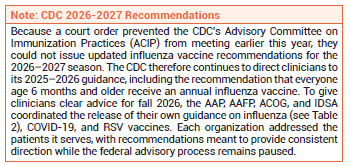
The American College of Obstetricians and Gynecologists (ACOG) recommends that pregnant women receive the vaccine at any time during pregnancy, preferably before the onset of influenza circulation in the community.5
Children 6 months to 8 years old who have received two lifetime doses of an influenza vaccine only need one dose this season. Those who require two doses should receive the first dose as early as possible so that the second dose can be given by the end of October (see Table 3, footnote 3). Vaccination in September or October is preferred for children who need only one dose, but administration in July or August can be considered.
EFFECTIVENESS — Influenza vaccination reduces the incidence of laboratory-confirmed influenza and the risk of serious complications and death associated with influenza illness.8-11 The effectiveness of the seasonal vaccine in preventing influenza illness depends on several factors, including the match between the vaccine and circulating strains and the immunologic response of the recipient. Vaccine effectiveness is greatest when the match is close, but even when it is suboptimal, vaccination can substantially reduce the risk of influenza-related hospitalization and death.12-14
During the 2025-2026 influenza season in the US, vaccination reduced the risk of influenza-associated hospitalization by 41% in children and adolescents, 29% in adults 18-64 years old, and 31% in adults ≥65 years old despite a poor match between circulating influenza A(H3N2) viruses and the corresponding vaccine strain (interim results).15
OLDER ADULTS — Older adults are at increased risk for severe influenza illness, hospitalization, and death. They may have a reduced immunogenic response to influenza vaccination compared to younger persons, and their antibody levels may decline more rapidly.16 Nevertheless, vaccination of older adults has been associated with a reduced risk of influenza-associated and respiratory hospitalization, recurrent hospitalization for ischemic heart disease, and in-hospital death.17,18
Four vaccines, the high-dose inactivated vaccine (Fluzone High-Dose), the adjuvanted inactivated vaccine (Fluad), the recombinant vaccine (Flublok), and the mRNA vaccine (mFLUSIVA), have been shown to be more effective than standard-dose inactivated vaccines in older adults. Few direct comparisons of these vaccines in older adults are available and there is insufficient evidence that any one is superior to any other.19
High-Dose Vaccine – Fluzone High-Dose, an inactivated vaccine that contains 4 times the amount of antigen included in standard-dose inactivated influenza vaccines, is FDA-licensed for use in persons ≥65 years old.
In a randomized, double-blind trial in a total of 31,989 adults ≥65 years old, Fluzone High-Dose induced significantly greater antibody responses than a standard-dose inactivated influenza vaccine and was 24% more effective in preventing laboratory-confirmed influenza illness.20
Use of a high-dose inactivated vaccine in adults ≥65 years old has been associated with a reduced risk of respiratory-related, cardiovascular-related, and all-cause hospitalization, and death compared to use of a standard-dose inactivated vaccine.21-29
In patients with high-risk cardiovascular disease (recent MI or hospitalization for heart failure), a high-dose inactivated vaccine elicited greater humoral responses than standard-dose inactivated vaccines, but it did not significantly reduce all-cause mortality or cardiopulmonary hospitalizations.30,31 In a prespecified pooled analysis of two randomized controlled trials, use of a high-dose influenza vaccine in adults ≥65 years old with or without pre-existing cardiovascular disease significantly reduced hospitalizations for cardiovascular disease, respiratory disease, and heart failure compared to use of a standard-dose vaccine.32
Adjuvanted Vaccine – Fluad, an adjuvanted inactivated influenza vaccine, is FDA-licensed for use in persons ≥65 years old. It contains MF59, an oil-in-water emulsion of squalene oil that increases the immune response by recruiting antigen-presenting cells to the injection site and promoting uptake of influenza virus antigens.
In a randomized trial in 7082 adults ≥65 years old, Fluad elicited significantly greater antibody responses than a nonadjuvanted, standard-dose inactivated vaccine.33
In observational studies and randomized trials, older adults who received an adjuvanted inactivated vaccine were less likely to develop symptomatic influenza illness or to be hospitalized for influenza or pneumonia than those who received a nonadjuvanted, standard-dose inactivated vaccine.34-36
Recombinant Vaccine – Flublok, a recombinant influenza vaccine produced without use of influenza virus or chicken eggs, contains 3 times the amount of antigen included in standard-dose inactivated influenza vaccines. It is FDA-licensed for use in persons ≥9 years old.
In a retrospective cohort study in 12.7 million adults ≥65 years old vaccinated during the 2019-2020 influenza season, the recombinant quadrivalent vaccine was more effective in preventing hospitalizations than a nonadjuvanted, standard-dose inactivated quadrivalent vaccine, an adjuvanted trivalent vaccine, or a high-dose trivalent vaccine.37
In an observational study in more than 1.6 million adults 18-64 years old, the recombinant influenza vaccine was significantly more effective than standard-dose vaccines in preventing laboratory-confirmed influenza illness in those 50-64 years old.38
mRNA Vaccine – mFLUSIVA, an mRNA-based vaccine, is FDA-licensed for use in adults ≥50 years old.39 In a double-blind trial in 40,805 adults ≥50 years old during the 2024-2025 influenza season, the mRNA vaccine was significantly more effective than a standard-dose inactivated vaccine in preventing influenza illness. The relative efficacy of the mRNA vaccine was 26.6% in patients ≥50 years old and 27.4% in those ≥65 years old.40
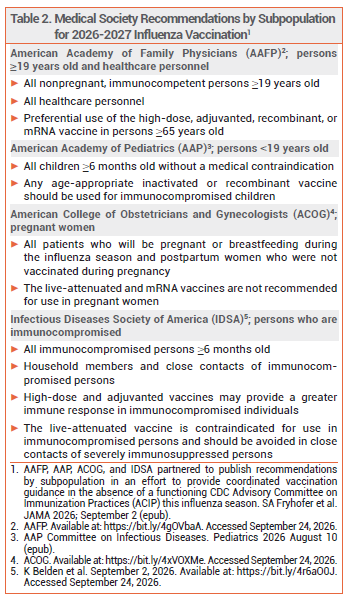
Choice of Vaccine in Older Adults – The CDC recommends that adults ≥65 years old receive either the high-dose, adjuvanted, or recombinant influenza vaccine (the mRNA vaccine was not licensed when their recommendations were issued); if none of these vaccines are available, any age-appropriate influenza vaccine should be given.1,2 The American Academy of Family Physicians (AAFP) recommends preferential use of the high-dose, adjuvanted, recombinant, or mRNA influenza vaccine in adults ≥65 years old.3 The American College of Cardiology (ACC) preferentially recommends use of the high-dose influenza vaccine for patients ≥65 years old with cardiovascular disease; they recommend the adjuvanted and recombinant vaccines as alternatives.41
PREGNANCY — Vaccination protects pregnant women against influenza-associated illness, which can be especially severe during pregnancy, and protects their infants for the first few months after birth (influenza vaccines are not licensed for use in infants <6 months old). Protection of infants against influenza-related emergency department visits and hospitalizations is greatest in those born to mothers who were vaccinated during the third trimester.42
Influenza vaccination during pregnancy is considered safe. In a meta-analysis of 31 studies, influenza vaccination in the first trimester was not associated with an increased risk of birth defects.43 In a prospective cohort study, exposure to an influenza vaccine before or during pregnancy was not associated with increased rates of miscarriage.44 In a retrospective cohort study with a mean follow-up of 3.6 years, influenza vaccination during pregnancy was not associated with an increased risk of adverse early childhood health outcomes, including asthma, infections, neoplasms, or hearing or vision loss.45 In another retrospective cohort study, maternal influenza vaccination was associated with reduced risks of low birth weight and preterm birth.46
The CDC and ACOG recommend vaccinating pregnant women against influenza (see Timing section).2,5,47 The live-attenuated intranasal vaccine and the mRNA vaccine should not be used during pregnancy.
EGG ALLERGY — The recombinant vaccine, the cell culture-based inactivated vaccine, and the mRNA vaccine do not contain egg protein. Other available influenza vaccines may contain trace amounts of egg protein (ovalbumin), but numerous studies have shown that persons with a history of egg allergy are not at increased risk for an adverse reaction to influenza vaccines that are propagated in eggs.48
The CDC, the American Academy of Pediatrics (AAP), and the Joint Task Force on Practice Parameters of the American Academy of Allergy Asthma and Immunology and the American College of Allergy Asthma and Immunology state that persons with a history of egg allergy of any severity can receive any age-appropriate influenza vaccine without the need for additional safety measures.2,4,49
IMMUNOCOMPROMISED PERSONS — The live-attenuated intranasal influenza vaccine should not be used in immunocompromised persons. Inactivated and recombinant influenza vaccines are generally considered safe for use in such persons, but the immune response may be reduced. Data on use of the mRNA vaccine in immunocompromised persons are limited.6
The Infectious Diseases Society of America (IDSA) states that the greater immune responses induced by the high-dose and adjuvanted influenza vaccines may be of particular importance in immunocompromised patients.6 In a randomized trial in solid-organ transplant recipients, vaccine response rates were higher with the high-dose and adjuvanted vaccines than with standard-dose inactivated vaccines.50 The CDC states that the high-dose inactivated vaccine and the adjuvanted inactivated vaccine are additional options (but not preferred over other age-appropriate options) for solid-organ transplant recipients 18-64 years old who are receiving immunosuppressive therapy.1,2
Separating the time of influenza vaccination from that of an immunocompromising intervention could be considered; recommendations for vaccination timing in select immunocompromised populations are available from the IDSA.6
USE WITH OTHER VACCINES — Any influenza vaccine can be given at the same time as a COVID-19 vaccine, but they should be administered in separate arms. The CDC states that coadministration of a respiratory syncytial virus (RSV) vaccine with other adult vaccines during the same visit is acceptable. RSV and influenza antibody titer levels are somewhat lower with coadministration than with sequential administration (~1 month apart).51 The AAFP recommends offering the influenza, COVID-19, and RSV vaccines at the same office visit.3
Inactivated and recombinant influenza vaccines can be administered concomitantly or sequentially with live, inactivated, or recombinant vaccines. The live-attenuated intranasal influenza vaccine can be given simultaneously with inactivated or other live vaccines; other live vaccines not administered simultaneously should be given at least 4 weeks later. Because of limited safety data on concurrent use of 2 or more adjuvanted vaccines, use of a nonadjuvanted influenza vaccine may be considered when another adjuvanted vaccine (e.g., Shingrix, Heplisav-B) is administered concurrently. No data are available on administration of the mRNA influenza vaccine with other vaccines.
USE WITH INFLUENZA ANTIVIRALS — Any inactivated or recombinant influenza vaccine can be administered to persons receiving antiviral drugs for treatment or chemoprophylaxis of influenza. Use of oseltamivir (Tamiflu, and generics) or zanamivir (Relenza) within 48 hours before, peramivir (Rapivab) within 5 days before, or baloxavir marboxil (Xofluza) within 17 days before administration of the live-attenuated intranasal influenza vaccine could inhibit replication of the vaccine virus, reducing its effectiveness. Persons who receive any of these antiviral drugs during these specified times or within 2 weeks after administration of the live-attenuated vaccine should be revaccinated with an inactivated or recombinant influenza vaccine.
ADVERSE EFFECTS — Influenza vaccination has been associated with Guillain-Barré syndrome, but the absolute risk is very low (about 1-2 additional cases per million persons vaccinated), and influenza infection itself has been associated with the syndrome (about 17 cases per million patients hospitalized with influenza).52 In a prospective cohort study in patients with diabetes, influenza vaccination was associated with hyperglycemia, but serum glucose levels returned to baseline 2 days after vaccination.53 Except for soreness at the injection site, adverse reactions to inactivated influenza vaccines are uncommon. In clinical trials, the high-dose vaccine caused more injection-site reactions than standard-dose vaccines. Pain and tenderness at the injection site also occurred more frequently with an adjuvanted influenza vaccine than with a nonadjuvanted vaccine. Injection-site pain, fatigue, headache, and myalgia occurred more frequently with the mRNA-based influenza vaccine than with a standard-dose inactivated vaccine. Myocarditis and pericarditis have been reported rarely with mRNA COVID-19 vaccines, primarily in adolescent and young adult males following the second dose54; no cases of myocarditis/pericarditis were reported with the mRNA-based influenza vaccine in clinical trials.
The most common adverse reactions associated with the live-attenuated intranasal vaccine are runny nose, nasal congestion, fever, and sore throat. The vaccine may increase the risk of wheezing, especially in children <5 years old with recurrent wheezing and in persons of any age with asthma. Persons who receive the live-attenuated vaccine may shed the vaccine-strain virus for a few days after vaccination, but person-to-person transmission has been rare, and serious illness resulting from transmission has not been reported. Nevertheless, the CDC recommends that persons who care for severely immunocompromised patients in protected environments avoid contact with such patients for 7 days after receiving the live-attenuated vaccine.1,2
In January 2026, the FDA required manufacturers to update the labels of influenza vaccines to include a warning about an increased risk of febrile seizures within the first day following vaccination in children 6 months to 4 years of age. The update was based on two postmarketing observational studies that reported a small, but statistically significant increase in the risk of febrile seizure within the first day post-vaccination compared to the risk within 8 to 63 days post-vaccination.4,55,56
- LA Grohskopf et al. Prevention and control of seasonal influenza with vaccines: recommendations of the Advisory Committee on Immunization Practices – United States, 2025-2026 influenza season. MMWR Recomm Rep 2025; 74:500. doi:10.15585/mmwr.mm7432a2
- CDC. Interim clinical considerations for the use of seasonal influenza vaccines in the United States. September 1, 2026. Available at: https://bit.ly/4Al7KlL. Accessed September 24, 2026.
- AAFP. 2026-2027 influenza, RSV and SARS-CoV-2 immunization recommendations for non-pregnant immunocompetent adults and health care personnel. Available at: https://bit.ly/46CjJ0w. Accessed September 24, 2026.
- AAP Committee on Infectious Diseases. Recommendations for prevention and control of influenza in children, 2026-2027: policy statement. Pediatrics 2026 August 10 (epub). doi:10.1542/peds.2026-078778
- ACOG. Influenza in pregnancy: prevention and treatment. Practice Advisory August 2025. Available at: https://bit.ly/4yQeyGq. Accessed September 24, 2026.
- K Belden et al. IDSA 2026 guidelines on the use of vaccines for prevention of seasonal COVID-19, influenza, and RSV infections in immunocompromised patients. September 2, 2026. Available at: https://bit.ly/47cQrFS. Accessed September 24, 2026.
- JM Ferdinands et al. Waning vaccine effectiveness against influenza-associated hospitalizations among adults, 2015-2016 to 2018-2019, United States Hospitalized Adult Influenza Vaccine Effectiveness Network. Clin Infect Dis 2021; 73:726. doi:10.1093/cid/ciab045
- JS Leonard et al. Influenza vaccine effectiveness against pediatric death in the United States: 2016-2025. Pediatrics 2026; 158:e2026076453. doi:10.1542/peds.2026-076453
- AP Campbell et al. Effect of vaccination on preventing influenza-associated hospitalizations among children during a severe season associated with B/Victoria viruses, 2019-2020. Clin Infect Dis 2021; 73:e947. doi:10.1093/cid/ciab060
- SM Olson et al. Pediatric vaccine effectiveness against influenza hospitalization and outpatient visits: 2021-2024. Pediatrics 2026; 157:e2025073973. doi:10.1542/peds.2025-073973
- E Senerth et al. Influenza vaccine effectiveness and safety for the 2026-2027 respiratory season. JAMA 2026 September 2 (epub). doi:10.1001/jama.2026.18126
- M Darvishian et al. Effectiveness of seasonal influenza vaccine in community-dwelling elderly people: a meta-analysis of test-negative design case-control studies. Lancet Infect Dis 2014; 14:1228. doi:10.1016/s1473-3099(14)70960-0
- NM Lewis et al. Vaccine effectiveness against influenza A-associated hospitalization, organ failure, and death: United States, 2022-2023. Clin Infect Dis 2024; 78:1056. doi:10.1093/cid/ciad677
- LC Sahni et al. Sustained within-season vaccine effectiveness against influenza-associated hospitalization in children: evidence from the New Vaccine Surveillance Network, 2015-2016 through 2019-2020. Clin Infect Dis 2023; 76:e1031. doi:10.1093/cid/ciac577
- P Maloney et al. Interim estimates of 2025-2026 seasonal influenza vaccine effectiveness – United States, September 2025-February 2026. MMWR Morb Mortal Wkly Rep 2026; 75:116. doi:10.15585/mmwr.mm7509a2
- B Young et al. Do antibody responses to the influenza vaccine persist year-round in the elderly? A systematic review and meta-analysis. Vaccine 2017; 35:212. doi:10.1016/j.vaccine.2016.11.013
- Y Pang et al. Effectiveness of influenza vaccination on in-hospital death and recurrent hospitalization in older adults with cardiovascular diseases. Int J Infect Dis 2022; 122:162. doi:10.1016/j.ijid.2022.05.059
- ZY Peng et al. Reduced risks of influenza-associated hospitalization and complications following vaccination among over 2 million older individuals: a nationwide study using target trial emulation framework. BMC Med 2025; 23:157. doi:10.1186/s12916-025-03955-w
- A Hsiao et al. Adjuvanted vs high-dose influenza vaccines in older US adults: a cluster randomized crossover study. JAMA Netw Open 2026; 9:e2610120. doi:10.1001/jamanetworkopen.2026.10120
- CA DiazGranados et al. Efficacy of high-dose versus standard-dose influenza vaccine in older adults. N Engl J Med 2014; 371:635. doi:10.1056/nejmoa1315727
- S Gravenstein et al. Comparative effectiveness of high-dose versus standard-dose influenza vaccination on numbers of US nursing home residents admitted to hospital: a cluster-randomised trial. Lancet Respir Med 2017; 5:738. doi:10.1016/s2213-2600(17)30235-7
- DK Shay et al. Comparative effectiveness of high-dose versus standard-dose influenza vaccines among US Medicare beneficiaries in preventing postinfluenza deaths during 2012-2013 and 2013-2014. J Infect Dis 2017; 215:510. doi:10.1093/infdis/jiw641
- KG Skaarup et al. High-dose vs standard-dose influenza vaccines in older adults: a meta-analysis. JAMA Netw Open 2026; 9:e2614620. doi:10.1001/jamanetworkopen.2026.14620
- JKH Lee et al. Efficacy and effectiveness of high-dose influenza vaccine in older adults by circulating strain and antigenic match: an updated systematic review and meta-analysis. Vaccine 2021; 39(Suppl 1):A24. doi:10.1016/j.vaccine.2020.09.004
- ND Johansen et al. A pragmatic randomized feasibility trial of influenza vaccines. NEJM Evid 2023; 2:EVIDoa2200206. doi:10.1056/evidoa2200206
- J Pardo-Seco et al. High-dose influenza vaccine to reduce hospitalizations. N Engl J Med 2025; 393:2303. doi:10.1056/nejmoa2509834
- ND Johansen et al. High-dose influenza vaccine effectiveness against hospitalization in older adults. N Engl J Med 2025; 393:2291. doi:10.1056/nejmoa2509907
- ND Johansen et al. High-dose vs standard-dose influenza vaccine and cardiovascular outcomes in older adults: a prespecified secondary analysis of the DANFLU-2 randomized clinical trial. JAMA Cardiol 2025; 10:1186. doi:10.1001/jamacardio.2025.3460
- ND Johansen et al. Effectiveness of high-dose influenza vaccine against hospitalisations in older adults (FLUNITY-HD): an individual-level pooled analysis. Lancet 2025; 406:2425. doi:10.1016/s0140-6736(25)01742-8
- O Vardeny et al. Effect of high-dose trivalent vs standard-dose quadrivalent influenza vaccine on mortality or cardiopulmonary hospitalization in patients with high-risk cardiovascular disease: a randomized clinical trial. JAMA 2021; 325:39. doi:10.1001/jama.2020.23649
- A Peikert et al. Influenza vaccine immune response in patients with high-risk cardiovascular disease: a secondary analysis of the INVESTED randomized clinical trial. JAMA Cardiol 2024; 9:574. doi:10.1001/jamacardio.2024.0468
- ND Johansen et al. High-dose versus standard-dose influenza vaccine and cardiovascular outcomes in older adults: the FLUNITY-HD prespecified pooled analysis. Circulation 2026; 153:798. doi:10.1161/circulationaha.125.077801
- SE Frey et al. Comparison of the safety and immunogenicity of an MF59-adjuvanted with a non-adjuvanted seasonal influenza vaccine in elderly subjects. Vaccine 2014; 32:5027. doi:10.1016/j.vaccine.2014.07.013
- PG Van Buynder et al. The comparative effectiveness of adjuvanted and unadjuvanted trivalent inactivated influenza vaccine (TIV) in the elderly. Vaccine 2013; 31:6122. doi:10.1016/j.vaccine.2013.07.059
- F Lapi et al. Adjuvanted versus nonadjuvanted influenza vaccines and risk of hospitalizations for pneumonia and cerebro/cardiovascular events in the elderly. Expert Rev Vaccines 2019; 18:663. doi:10.1080/1 4760584.2019.1622418
- KW McConeghy et al. Cluster-randomized trial of adjuvanted versus nonadjuvanted trivalent influenza vaccine in 823 US nursing homes. Clin Infect Dis 2021; 73:e4237. doi:10.1093/cid/ciaa1233
- HS Izurieta et al. Comparative effectiveness of influenza vaccines among US Medicare beneficiaries ages 65 years and older during the 2019-2020 season. Clin Infect Dis 2021; 73:e4251. doi:10.1093/cid/ciaa1727
- A Hsiao et al. Recombinant or standard-dose influenza vaccine in adults under 65 years of age. N Engl J Med 2023; 389:2245. doi:10.1056/nejmoa2302099
- mFLUSIVA – an mRNA-based influenza vaccine. Med Lett Drugs Ther 2026; 68:150.
- I Leroux-Roels et al. Efficacy and safety of an mRNA seasonal influenza vaccine in adults. N Engl J Med 2026; 394:1803. doi:10.1056/nejmoa2516491
- PA Heidenreich et al. Adult immunizations as part of cardiovascular care: 2026 ACC concise clinical guidance: a report of the American College of Cardiology Solution Set Oversight Committee. J Am Coll Cardiol 2026 August 5 (epub). doi:10.1016/j.jacc.2026.07.004
- LC Sahni et al. Maternal vaccine effectiveness against influenza-associated hospitalizations and emergency department visits in infants. JAMA Pediatr 2024; 178:176. doi:10.1001/jamapediatrics.2023.5639
- Y Wu et al. Maternal influenza vaccination during the first trimester of pregnancy and risk for birth defects: an updated systematic review and meta-analysis. BMC Pregnancy Childbirth 2026; 26:713. doi:10.1186/ s12884-026-09238-3
- AK Regan et al. Risk of miscarriage in relation to seasonal influenza vaccination before or during pregnancy. Obstet Gynecol 2023; 142:625. doi:10.1097/aog.0000000000005279
- A Mehrabadi et al. Association of maternal influenza vaccination during pregnancy with early childhood health outcomes. JAMA 2021; 325:2285. doi:10.1001/jama.2021.6778
- X Zhang et al. The impact of maternal influenza infection and vaccination during pregnancy on birth outcomes. Pediatr Infect Dis J 2026; 45:789. doi:10.1097/inf.0000000000005194
- CDC. Influenza vaccine benefits and safety considerations during pregnancy or while breastfeeding. January 16, 2025. Available at: https://bit.ly/46b12Am. Accessed September 24, 2026.
- M Greenhawt et al. Administration of influenza vaccines to egg allergic recipients: a practice parameter update 2017. Ann Allergy Asthma Immunol 2018; 120:49. doi:10.1016/j.anai.2017.10.020
- American Academy of Allergy Asthma & Immunology. Egg allergy and the flu vaccine. August 11, 2026. Available at: https://bit.ly/4xHgBLY. Accessed September 24, 2026.
- M Mombelli et al. Immunogenicity of high-dose versus MF59-adjuvanted versus standard influenza vaccine in solid organ transplant recipients: the Swiss/Spanish trial in solid organ transplantation on prevention of influenza (STOP-FLU trial). Clin Infect Dis 2024; 78:48. doi:10.1093/cid/ciad477
- M Melgar et al. Use of respiratory syncytial virus vaccines in older adults: recommendations of the Advisory Committee on Immunization Practices – United States, 2023. MMWR Morb Mortal Wkly Rep 2023; 72:793. doi:10.15585/mmwr.mm7229a4
- A Babazadeh et al. Influenza vaccination and Guillain-Barré syndrome: reality or fear. J Transl Int Med 2019; 7:137. doi:10.2478/jtim-2019- 0028
- AL Hulsizer et al. Hyperglycemia post-influenza vaccine in patients with diabetes. Ann Pharmacother 2023; 57:51. doi:10.1177/10600280221098101
- COVID-19 update: mRNA COVID-19 vaccines and myocarditis. Med Lett Drugs Ther 2025; 67:119.
- PC Lloyd et al. Safety monitoring of health outcomes following influenza vaccination during the 2023-2024 season among U.S. commercially-insured individuals aged 6 months through 64 years: self-controlled case series analysis. Vaccine 2025; 63:127614. doi:10.1016/j.vaccine.2025.127614
- FDA. 2026 Safety and availability communications. September 14, 2026. Available at: https://bit.ly/4AqHoyG. Accessed September 24, 2026.

 Previous article