


ISSUE1766


- Jean-Marie Pflomm, Pharm.D., Editor in Chief has disclosed no relevant financial relationships.
- Amy Faucard, MLS, Associate Editor has disclosed no relevant financial relationships.
- Review the COVID-19 vaccines available for 2026-2027 and describe the recommendations for their use.
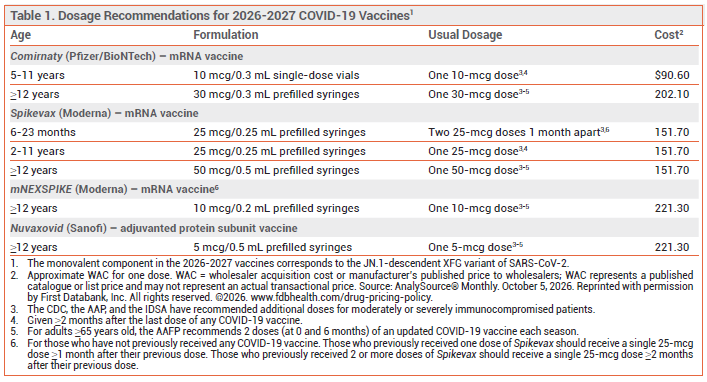
The FDA has licensed 2026-2027 formulas of the mRNA COVID-19 vaccines Comirnaty, Spikevax, and mNEXSPIKE1 and the adjuvanted protein subunit COVID-19 vaccine Nuvaxovid.
The vaccines are FDA-licensed for use in adults ≥65 years old and in persons aged 6 months-64 years (Spikevax), 5-64 years (Comirnaty), or 12-64 years (mNEXSPIKE, Nuvaxovid) who are at high risk for severe COVID-19 because of an underlying condition.
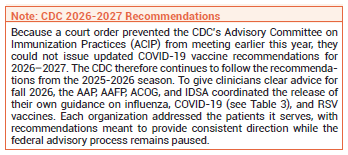
THE NEW FORMULAS — The 2026-2027 COVID-19 vaccines are monovalent. They target the spike protein of the XFG Omicron strain of SARS-CoV-2, which is descended from the JN.1 strain and is currently the dominant circulating strain in the US.2 Comirnaty and Spikevax code for the entire spike protein; mNEXSPIKE codes only for the N-terminal and receptor-binding domains of the spike protein. Nuvaxovid contains a recombinant form of the spike protein.
DOSAGE AND ADMINISTRATION — For most patients, a single dose of a 2026-2027 COVID-19 vaccine administered ≥2 months after any previous COVID-19 vaccine dose is recommended. Additional doses are recommended for immunocompromised patients,3,4 children 6-23 months old who have never been vaccinated against COVID-19, and adults ≥65 years old (see Table 1).
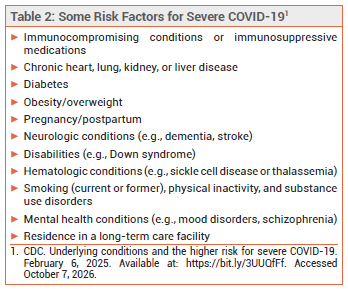
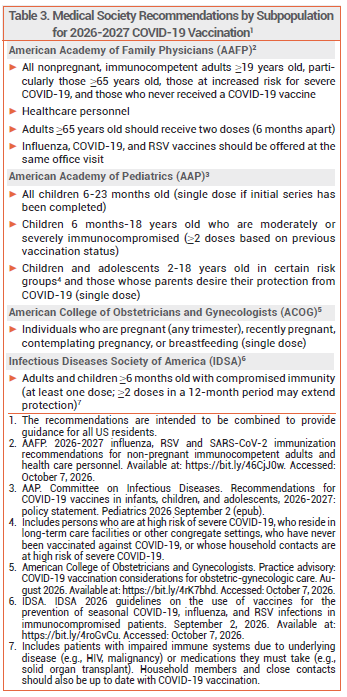
RECOMMENDATIONS — The risk of severe outcomes from COVID-19 is highest in older adults, persons with underlying medical conditions, and residents of long-term care facilities (see Table 2). The CDC recommends COVID-19 vaccination for all persons ≥18 years old and for children 6 months-17 years old with moderate to severe immunocompromise; they say the decision to vaccinate other children should be based on shared clinical decision-making.5 Four medical societies have provided 2026-2027 vaccination recommendations for specific patient populations according to their individual areas of specialization (see Table 3); the recommendations are intended to be combined to provide guidance for all US residents.4,6-8
EFFECTIVENESS — Licensure of the 2026-2027 vaccines was based on the immunogenicity, safety, and effectiveness of previous vaccines. In previous seasons, COVID-19 vaccination has been associated with reductions in the risk of severe disease, emergency department visits, hospitalizations, and deaths in children, adults, and persons with immunocompromising conditions.9-12
ADVERSE EFFECTS — Adverse effects of currently licensed US COVID-19 vaccines have included injection-site reactions, fatigue, fever, chills, muscle and joint pain, headache, nausea, vomiting, and lymphadenopathy. Vaccine-related serious adverse events have been rare. Severe allergic reactions have occurred.
Myocarditis and pericarditis have occurred rarely following COVID-19 vaccination; the incidence has been highest in adolescent and young adult males.13 Myocarditis and pericarditis can also occur with SARS-CoV-2 infection.14
PREGNANCY AND LACTATION — SARS-CoV-2 infection has been associated with an increased risk of adverse pregnancy outcomes. In a retrospective cohort study of in-hospital deliveries, pregnant women infected with SARS-CoV-2 had higher rates of severe morbidity, ICU admission, and in-hospital mortality; increased risks of preterm birth, cesarean delivery, and fetal death at ≥20 weeks' gestation were also observed.15
COVID-19 vaccination has been shown to protect pregnant women against adverse outcomes while providing passive immunity to their infants.16-20 Administration of COVID-19 vaccines to breastfeeding women is considered safe.6
The American College of Obstetricians and Gynecologists (ACOG) recommends COVID-19 vaccination for women who are pregnant (any trimester), recently pregnant, contemplating pregnancy, or breastfeeding.6
- COVID-19 update: mNexspike – a new Moderna mRNA vaccine for COVID-19. Med Lett Drugs Ther 2025; 67:119.
- CDC. Variants and genomic surveillance. August 28, 2025. Available at: https://bit.ly/4B7NzYX. Accessed: October 7, 2026.
- CDC. COVID-19 vaccination guidance for people who are immunocompromised. September 23, 2026. Available at: https://bit.ly/4rqKz56. Accessed: October 7, 2026.
- Infectious Diseases Society of America. IDSA 2026 guidelines on the use of vaccines for the prevention of seasonal COVID-19, influenza, and RSV infections in immunocompromised patients. September 2, 2026. Available at https://bit.ly/4roGvCu. Accessed: October 7, 2026.
- CDC. Interim clinical considerations for use of COVID-19 vaccines in the United States. September 23, 2026. Available at: https://bit.ly/3VKN7PQ. Accessed October 7, 2026.
- American College of Obstetricians and Gynecologists. Practice advisory: COVID-19 vaccination considerations for obstetric-gynecologic care. August 2026. Available at: https://bit. ly/4rK7bhd. Accessed: October 7, 2026.
- American Academy of Family Physicians. 2026-2027 influenza, RSV and SARS-CoV-2 immunization recommendations for non-pregnant immunocompetent adults and health care personnel. Available at: https://bit.ly/46CjJ0w. Accessed: October 7, 2026.
- American Academy of Pediatrics. Committee on Infectious Diseases. Recommendations for COVID-19 vaccines in infants, children, and adolescents, 2026-2027: policy statement. Pediatrics 2026 September 2 (epub).
- RA Lipson et al. COVID-19 vaccine effectiveness and safety for the 2026-2027 respiratory season. JAMA 2026 September 2 (epub). doi:10.1001/jama.2026.18191
- N Vicic et al. Interim effectiveness of 2025-2026 mRNA-1283 and BNT162b2 COVID-19 vaccines against COVID-19-related outcomes among adults aged ≥65 years in the United States. Infect Dis Ther 2026; 15:2307. doi:10.1007/s40121-026-01395-4
- HJ Appaneal et al. BNT162b2 LP.8.1 early vaccine effectiveness against COVID-19 emergency department, urgent care, and outpatient visits. Nat Commun 2026; 17:6912. doi:10.1038/s41467-026-73798-3
- RE Wiegand et al. Interim estimated effectiveness of 2025-2026 COVID-19 vaccines in adults using a test-negative design. JAMA Netw Open 2026; 9:e2625152. doi:10.1001/jamanetworkopen.2026.25152
- COVID-19 update: mRNA COVID-19 vaccines and myocarditis. Med Lett Drugs Ther 2025; 67:119.
- EA Toraih et al. Cardiac outcomes following SARS-CoV-2 infection versus BNT162b2 vaccination in adolescents and young adults: a cohort study of 4 million individuals. Vaccine 2026; 91:129001. doi:10.1016/j.vaccine.2026.129001
- D Kilday et al. Association between COVID-19 by variant period and delivery-related outcomes in the United States. PLoS One 2026; 21:e0355223. doi:10.1371/journal.pone.0355223
- LH Zauche et al. Neonatal and infant health outcomes following maternal COVID-19 vaccination: CDC’s COVID-19 vaccine pregnancy registry. J Pediatr Health Care 2026 July 22 (epub). doi:10.1016/j.pedhc.2026.06.017
- SA Madni et al. Risk of perinatal death and preterm birth among an observational cohort of women vaccinated against SARS-CoV-2 in pregnancy: CDC COVID-19 vaccine pregnancy registry. Vaccine 2026; 79:128461. doi:10.1016/j.vaccine.2026.128461
- AA Ciesla et al. Effectiveness of 2023-2024 coronavirus disease 2019 (COVID-19) vaccines in pregnant women. Obstet Gynecol 2026; 147:569. doi:10.1097/aog.0000000000006145
- E McClymont et al. The role of vaccination in maternal and perinatal outcomes associated with COVID-19 in pregnancy. JAMA 2026; 335:154. doi:10.1001/jama.2025.21001
- HN Eide et al. COVID-19 mRNA vaccination in pregnancy and risk of infection in early childhood. Pediatrics 2026 March 20 (epub). doi:10.1542/peds.2025-073661

 Previous article