


ISSUE1766


- Jean-Marie Pflomm, Pharm.D., Editor in Chief has disclosed no relevant financial relationships.
- Brinda M. Shah, Pharm.D., Consulting Editor has disclosed no relevant financial relationships.
- Discuss the use of inhaled insulin (Afrezza) in children with type 1 or type 2 diabetes.
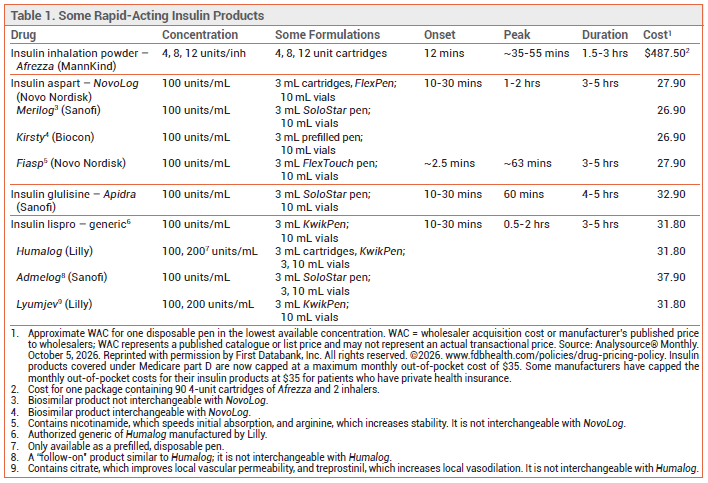
The rapid-acting inhaled human insulin Afrezza (MannKind), which was approved in 2014 for treatment of type 1 or type 2 diabetes in adults, has now been approved by the FDA for use in children ≥6 years old.1

A CLINICAL STUDY — FDA approval of the expanded indication was based on the results of a double-blind noninferiority trial (INHALE-1) in 230 children 4-17 years old with type 1 (98%) or type 2 diabetes (2%) who were receiving multiple daily insulin injections. Patients were randomized to receive inhaled insulin or a subcutaneous (SC) rapid-acting insulin analog, each in addition to basal insulin. At 26 weeks, the mean change from baseline in A1C was +0.19% with inhaled insulin and 0% with SC insulin. Inhaled insulin was associated with greater patient satisfaction and less weight gain than SC insulin.2
In an extension of the INHALE-1 trial, the mean change in A1C from 26 to 52 weeks was +0.38% in patients who continued using inhaled insulin and +0.31% in patients who switched from SC to inhaled insulin.3
DOSAGE AND ADMINISTRATION — Afrezza is packaged in blue, green, or yellow cartridges containing 4, 8, or 12 units, respectively, of rapid-acting insulin. One single-use cartridge should be inserted into the palm-sized, breath-powered, dry-powder inhaler device. The drug is administered as a single inhalation. Doses >12 units require use of more than 1 cartridge. The inhaler must be replaced after 15 days.
Afrezza should be administered at the beginning of each meal. The recommended initial dose for insulin-naive patients is 4 units per meal. For patients switching from SC insulin, the starting dose of Afrezza should be based on their current mealtime insulin dose rounded up to the nearest multiple of 4. Afrezza is contraindicated for use in patients with chronic lung disease such as asthma or COPD because of the risk of bronchospasm. It should not be used by patients who smoke or who stopped smoking <6 months earlier.
- An inhaled insulin (Afrezza). Med Lett Drugs Ther 2015; 57:34.
- MJ Haller et al. INHALE-1: a multicenter randomized trial of inhaled technosphere insulin in children with type 1 diabetes. Diabetes Care 2026; 49:179. doi:10.2337/dc25-1994
- RW Beck et al. Inhaled technosphere insulin in children with diabetes: the INHALE-1 extension study. Diabetes Technol Ther 2026; 28:772. doi:10.1177/15209156261420176

 Previous article