


ISSUE1767


- Jean-Marie Pflomm, Pharm.D., Editor in Chief has disclosed no relevant financial relationships.
- Corinne Z. Morrison, Pharm.D., Associate Editor has disclosed no relevant financial relationships.
- Discuss the current recommendations for antiviral treatment and prophylaxis of seasonal influenza.
- Compare the antiviral drugs available for treatment of influenza based on their efficacy, dosage and administration, and potential adverse effects.
- Determine the most appropriate regimen for treatment or prophylaxis of influenza in a particular patient.
- Antiviral treatment is most effective when started ≤48 hours after illness onset.
- Antiviral treatment is recommended as soon as possible for patients with suspected or confirmed influenza who are hospitalized, have severe, complicated, or progressive illness, or are at increased risk for complications, even if it is started >48 hours after illness onset.
- Antiviral treatment can be considered for otherwise healthy symptomatic outpatients with suspected or confirmed influenza who are not at increased risk for complications if it can be started ≤48 hours after illness onset.
- Oseltamivir is preferred for treatment of children, pregnant women, hospitalized patients, and outpatients with severe, complicated, or progressive illness.
- Postexposure prophylaxis with oseltamivir, zanamivir, or baloxavir should be considered within 48 hours of exposure for persons at high risk of complications who have not received an annual influenza vaccine or when influenza vaccination may be ineffective; it is not recommended for healthy persons exposed to influenza.
- Postexposure prophylaxis with oseltamivir or zanamivir is recommended to control influenza outbreaks in institutional settings.
Influenza is typically a self-limited illness, but complications including pneumonia, respiratory failure, and death can occur, especially in persons at increased risk (see Table 1). Influenza vaccination reduces the incidence of laboratory-confirmed influenza and the risk of complications associated with influenza illness. Annual vaccination should be offered to all persons ≥6 months old as long as influenza viruses are circulating in the community.1
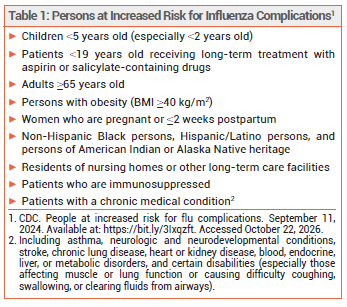
TREATMENT OF INFLUENZA — Antiviral treatment is recommended as soon as possible for any patient with suspected or confirmed influenza who is hospitalized, has severe, complicated, or progressive illness, or is at increased risk for complications (see Table 1), even if it is started >48 hours after illness onset.2-4 Such patients should receive antiviral treatment even if they test negative, especially when influenza viruses are known to be circulating in the community; false-negative results can occur with influenza tests, especially with rapid antigen tests and immunofluorescence assays.5
Guidelines for treatment of community-acquired pneumonia (CAP) recommend use of antiviral drugs in patients with CAP and confirmed influenza who are hospitalized, have severe or progressive illness, or are at an increased risk of complications, regardless of the time from illness onset.6
Antiviral treatment can be considered for otherwise healthy symptomatic outpatients with suspected or confirmed influenza who are not at increased risk for complications if it can be started ≤48 hours after illness onset.
Three neuraminidase inhibitors (oral oseltamivir, IV peramivir, and inhaled zanamivir) and the oral cap-dependent endonuclease inhibitor baloxavir marboxil are recommended for treatment of influenza in the US this season (see Table 2).2 Oseltamivir is preferred for treatment of influenza in pregnant women, children, hospitalized patients, and outpatients with severe, complicated, or progressive illness.2-4
Effectiveness – Neuraminidase inhibitors and baloxavir are active against influenza A and B viruses. In adults and children with acute uncomplicated influenza, they shorten the duration of symptoms by about one day.5-11 Randomized trials directly comparing these drugs for treatment of influenza are lacking, but they appear to be similar in efficacy based on available data from observational studies.9,10,12,13 Although most controlled trials of antiviral drugs have not been powered to assess their efficacy in preventing serious influenza complications, experts have generally concluded from the combined results of observational studies, controlled trials, and meta-analyses that early antiviral treatment of influenza in high-risk and hospitalized patients can reduce the risk of complications.7,9-12,14-19 In a randomized trial (available as a preprint, but not yet peer-reviewed) in critically-ill patients with severe influenza illness, use of oseltamivir was associated with a higher rate of mortality at 90 days compared to no antiviral treatment20; formal peer review of the manuscript is needed.
Prompt treatment of an index patient with baloxavir can reduce the risk of influenza transmission to household contacts.21
Timing – Neuraminidase inhibitors are most effective when started ≤48 hours after illness onset, but the results of some observational studies in hospitalized and critically ill patients suggest that treatment started as late as 4-5 days after illness onset can shorten the duration of hospitalization and reduce the risk of pneumonia, respiratory failure, and death.22-24 No data are available on the efficacy of baloxavir when started >48 hours after illness onset.
In a retrospective cohort study of 26,233 hospitalized adults with laboratory-confirmed influenza and pneumonia, delayed initiation of antiviral treatment was associated with a higher risk of death; compared to patients who started antiviral treatment on day 0, the adjusted odds ratio for death was 1.14 (95% CI 1.01-1.27) in those who started treatment on day 1 and 1.40 (95% CI 1.17-1.66) in those who started on days 2-5.25
In an observational study in 840 hospitalized adults with influenza, the risk of disease progression, ICU admission, and in-hospital death was lower with early use of oseltamivir than with no use or late use of the drug.26
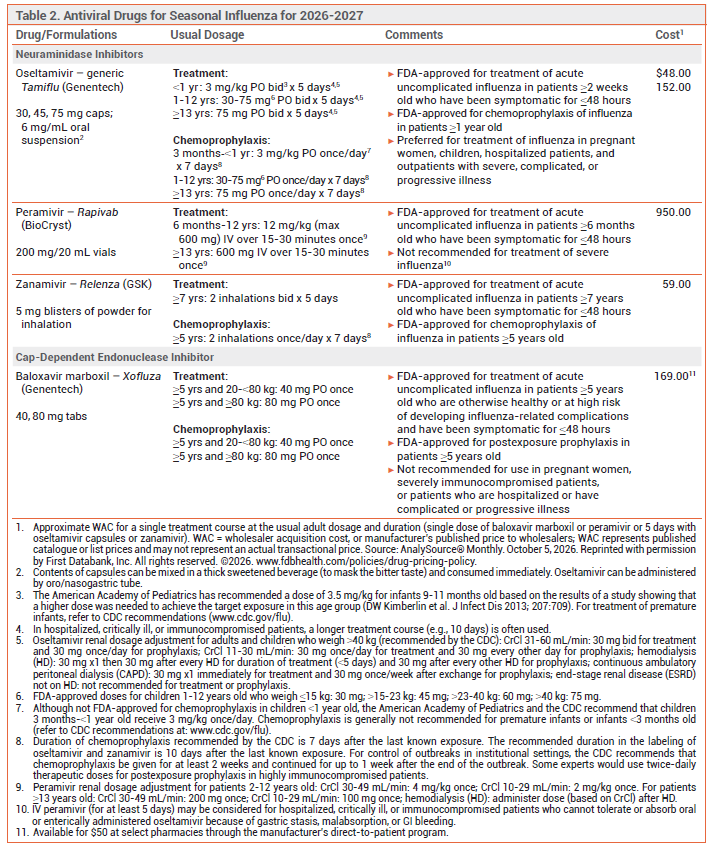
View the Comparison Chart: Antiviral Drugs for Seasonal Influenza
POSTEXPOSURE PROPHYLAXIS — Postexposure antiviral prophylaxis can be considered for persons who are at very high risk of developing influenza complications and have not or cannot receive an influenza vaccine for the current season or who are expected to have an inadequate response to vaccination. It may be considered for unvaccinated persons who are household contacts of persons at very high risk of influenza complications. Postexposure antiviral prophylaxis is not recommended for healthy persons exposed to influenza or when >48 hours have elapsed since exposure.2,3
Antiviral prophylaxis with oral oseltamivir or inhaled zanamivir is recommended by the CDC for control of influenza outbreaks in institutional settings.2
Effectiveness – Postexposure prophylaxis of household contacts with oseltamivir, zanamivir, or baloxavir has reduced the risk of symptomatic influenza illness by about 70-90%, compared to placebo.2,27
Timing – Antiviral prophylaxis with oseltamivir, zanamivir, or baloxavir should be started no later than 48 hours after exposure. Oseltamivir and zanamivir should be taken for 7 days after the last known exposure. Baloxavir is taken as a single dose.
The CDC recommends postexposure prophylaxis with oral oseltamivir or inhaled zanamivir for at least 2 weeks for institutional influenza outbreaks; it should be continued for up to 1 week after the end of the outbreak.
PREGNANCY AND LACTATION — Pregnant and postpartum women are at increased risk for complications of influenza. Empiric antiviral treatment should be started as soon as possible in those with suspected or confirmed influenza. Oseltamivir is preferred for women who are pregnant, postpartum (≤2 weeks), or breastfeeding. Zanamivir and peramivir are alternatives. Baloxavir is not recommended for use in pregnant or breastfeeding women because of a lack of data.28-32
Antiviral postexposure prophylaxis can be considered for pregnant women and those who are ≤2 weeks postpartum who cannot receive an influenza vaccine or are unlikely to respond to influenza vaccination. Oseltamivir is preferred.30,31
RESISTANCE — Over 99% of recently circulating influenza virus strains tested by the World Health Organization have been susceptible to neuraminidase inhibitors and baloxavir.33 Reduced susceptibility of some influenza virus strains, particularly influenza A(H1N1) viruses, to oseltamivir or peramivir can emerge during or after treatment, especially in young children and immunocompromised patients with prolonged viral shedding.34-39 Resistant isolates have usually remained susceptible to zanamivir, but reduced susceptibility to the drug has been reported.40 In immunocompromised patients, a double dose of oseltamivir reduced the incidence of oseltamivir resistance compared to standard dosing, but it did not improve efficacy and caused more adverse effects.41
Amino acid substitutions associated with reduced susceptibility to baloxavir have occurred following treatment with a single dose of the drug.8,21,42 Reduced susceptibility to baloxavir appears to be more frequent in persons infected with influenza A(H3N2) or A(H1N1)pdm09 viruses, particularly children.33,43,44 Baloxavir monotherapy is not recommended for use in severely immunocompromised patients because of concerns that prolonged viral replication in such patients could lead to emergence of resistance.2 Oseltamivir and peramivir may be active against influenza virus strains with reduced susceptibility to baloxavir.45 Baloxavir is active against neuraminidase inhibitor-resistant strains of influenza A and B viruses, including A(H1N1), A(H5N1), A(H3N2), and A(H7N9).
ADVERSE EFFECTS — Nausea, vomiting, and headache are the most common adverse effects of oseltamivir; taking the drug with food may minimize GI adverse effects. Oseltamivir has been associated with bradycardia in critically ill patients.46 Headache, diarrhea, nausea, vomiting, bronchitis, cough, sinusitis, and ear, nose, and throat infections have been reported with zanamivir. Inhalation of zanamivir can cause bronchospasm; the drug should not be used in patients with underlying airway disease. Diarrhea, vomiting, and neutropenia have occurred with peramivir.47 Baloxavir appears to cause less nausea and vomiting than oseltamivir.48
Neuropsychiatric events, including self-injury and delirium, have been reported in patients taking neuraminidase inhibitors or baloxavir, but a causal relationship has not been established, and neuropsychiatric dysfunction can be a complication of influenza itself. In a retrospective cohort study of children 5-17 years old enrolled in Tennessee Medicaid during the 2016-2017 and 2019-2020 influenza seasons, oseltamivir use was associated with lower rates of neuropsychiatric events than untreated influenza (34.8% vs 59.9%; adjusted risk ratio 0.53, 95% CI 0.33-0.88).49
Hypersensitivity reactions, including anaphylaxis, have been reported with all of these drugs.
DRUG INTERACTIONS — Coadministration of dairy products, beverages, antacids, laxatives, multivitamins, or other products containing polyvalent cations (e.g., calcium, aluminum, iron, magnesium, selenium, zinc) can reduce serum concentrations of baloxavir and should be avoided.
USE WITH THE LIVE-ATTENUATED VACCINE — Use of oseltamivir or zanamivir within 48 hours before, peramivir within 5 days before, or baloxavir within 17 days before administration of the live-attenuated intranasal influenza vaccine (FluMist, FluMist Home) could inhibit replication of the vaccine virus, reducing the vaccine's effectiveness, and is not recommended.1 Persons who receive any of these antiviral drugs during these specified times or within 2 weeks after receiving the live-attenuated vaccine should be revaccinated with an injectable influenza vaccine.50,51
View the Comparison Chart: Antiviral Drugs for Seasonal Influenza
- Seasonal influenza vaccination: 2026-2027. Med Lett Drugs Ther 2026; 68:161.
- CDC. Influenza antiviral medications: summary for clinicians. March 10, 2026. Available at: https://bit.ly/4drnAkI. Accessed October 22, 2026.
- TM Uyeki et al. Clinical practice guidelines by the Infectious Diseases Society of America: 2018 update on diagnosis, treatment, chemoprophylaxis, and institutional outbreak management of seasonal influenza. Clin Infect Dis 2019; 68:895. doi:10.1093/cid/ciy874
- American Academy of Pediatrics, Committee on Infectious Diseases. Recommendations for prevention and control of influenza in children, 2025-2026: policy statement. Pediatrics 2025; 156:e2025073620. doi:10.1542/peds.2025-073620
- CDC. Interpreting influenza testing results when influenza is circulating for health care settings. December 19, 2025. Available at: https://bit.ly/4iFHFaD. Accessed October 22, 2026.
- JP Metlay et al. Diagnosis and treatment of adults with community-acquired pneumonia: an official clinical practice guideline of the American Thoracic Society and Infectious Diseases Society of America. Am J Respir Crit Care Med 2019; 200:e45. doi:10.1164/rccm.201908-1581st
- CC Butler et al. Oseltamivir plus usual care versus usual care for influenza-like illness in primary care: an open-label, pragmatic, randomised controlled trial. Lancet 2020; 395:42. doi:10.1016/s0140-6736(19)32982-4
- FG Hayden et al. Baloxavir marboxil for uncomplicated influenza in adults and adolescents. N Engl J Med 2018; 379:913. doi:10.1056/nejmoa1716197
- MG Ison et al. Early treatment with baloxavir marboxil in high-risk adolescent and adult outpatients with uncomplicated influenza (CAPSTONE-2): a randomised, placebo-controlled, phase 3 trial. Lancet Infect Dis 2020; 20:1204. doi:10.1016/1473-3099(20)30004-9
- Y Gao et al. Antiviral medications for treatment of nonsevere influenza: a systematic review and network meta-analysis. JAMA Intern Med 2025; 185:293. doi:10.1001/jamainternmed.2024.7193
- RE Malosh et al. Efficacy and safety of oseltamivir in children: systematic review and individual patient data meta-analysis of randomized controlled trials. Clin Infect Dis 2018; 66:1492. doi:10.1093/cid/cix1040
- AD Bai et al. Oseltamivir treatment vs supportive care for seasonal influenza requiring hospitalization. JAMA Netw Open 2025; 8:e2514508. doi:10.1001/jamanetworkopen.2025.14508
- JS Lee et al. Clinical effectiveness of intravenous peramivir versus oseltamivir for the treatment of influenza in hospitalized patients. Infect Drug Resist 2020; 13:1479. doi:10.2147/idr.s247421
- HC Su et al. Comparative effectiveness of neuraminidase inhibitors in patients with influenza: a systematic review and network meta-analysis. J Infect Chemother 2022; 28:158. doi:10.1016/j.jiac.2021.11.014
- J Katzen et al. Early oseltamivir after hospital admission is associated with shortened hospitalization: a 5-year analysis of oseltamivir timing and clinical outcomes. Clin Infect Dis 2019; 69:52. doi:10.1093/cid/ciy860
- Y Sharma et al. Effectiveness of oseltamivir in reducing 30-day readmissions and mortality among patients with severe seasonal influenza in Australian hospitalized patients. Int J Infect Dis 2021; 104:232. doi:10.1016/j.ijid.2021.01.011
- Y Gao et al. Antivirals for treatment of severe influenza: a systematic review and network meta-analysis of randomised controlled trials. Lancet 2024; 404:753. doi:10.1016/s0140- 6736(24)01307-2
- AP Campbell et al. Influenza antiviral treatment and length of stay. Pediatrics 2021; 148:e2021050417. doi:10.1542/peds.2021-050417
- K Rytlewski et al. Effectiveness of oseltamivir in hospitalized children with laboratory-confirmed influenza, 2014-2023. JAMA Pediatr 2026; 180:1116. doi:10.1001/jamapediatrics.2026.3376
- S Murthy et al. Oseltamivir for critically ill patients with influenza: a randomised trial. Lancet 2026 Jul 27 (preprint). doi:10.2139/ssrn.7172531
- AS Monto et al. Efficacy of baloxavir treatment in preventing transmission of influenza. N Engl J Med 2025; 392:1582. doi:10.1056/nejmoa2413156
- JK Louie et al. Neuraminidase inhibitors for critically ill children with influenza. Pediatrics 2013; 132:e1539. doi:10.1542/peds.2013-2149
- SG Muthuri et al. Effectiveness of neuraminidase inhibitors in reducing mortality in patients admitted to hospital with influenza A H1N1pdm09 virus infection: a meta-analysis of individual participant data. Lancet Respir Med 2014; 2:395. doi:10.1016/s2213-2600(14)70041-4
- JK Louie et al. Treatment with neuraminidase inhibitors for critically ill patients with influenza A (H1N1)pdm09. Clin Infect Dis 2012; 55:1198. doi:10.1093/cid/cis636
- MW Tenforde et al. Timing of influenza antiviral therapy and risk of death in adults hospitalized with influenza-associated pneumonia, influenza hospitalization surveil-lance network (FluServ-NET), 2012-2019. Clin Infect Dis 2025; 80:461. doi:10.1093/cid/ciae427
- NM Lewis et al. Benefit of early oseltamivir therapy for adults hospitalized with influenza A: an observational study. Clin Infect Dis 2025; 81:190. doi:10.1093/cid/ciae584
- H Ikematsu et al. Baloxavir marboxil for prophylaxis against influenza in household contacts. N Engl J Med 2020; 383:309. doi:10.1056/nejmoa1915341
- EJ Chow et al. Clinical effectiveness and safety of antivirals for influenza in pregnancy. Open Forum Infect Dis 2021; 8:ofab138. doi:10.1093/ofid/ofab138
- V Ehrenstein et al. Oseltamivir in pregnancy and birth outcomes. BMC Infect Dis 2018; 18:519. doi:10.1186/s12879-018-3423-z
- American College of Obstetricians and Gynecologists. Practice advisory: Influenza in pregnancy: prevention and treatment. August 2025. Available at: https://bit.ly/4Aw62hu. Accessed October 22, 2026.
- CDC. Recommendations for obstetric health care providers related to use of antiviral medications for the treatment and prevention of influenza. December 19, 2025. Available at: https://bit.ly/4iIGSpo. Accessed October 22, 2026.
- IK Oboho et al. Benefit of early initiation of influenza antiviral treatment to pregnant women hospitalized with laboratory-confirmed influenza. J Infect Dis 2016; 214:507. doi:10.1093/infdis/jiw033
- S Hussain et al. Global update on the susceptibilities of influenza viruses to neuraminidase inhibitors and the cap-dependent endonuclease inhibitor baloxavir, 2020-2023. Antiviral Res 2025; 241:106217. doi:10.1016/j.antiviral.2025.106217
- AC Hurt et al. Characteristics of a widespread community cluster of H275Y oseltamivir-resistant A(H1N1)pdm09 influenza in Australia. J Infect Dis 2012; 206:148. doi:10.1093/infdis/jis337
- C Renaud et al. H275Y mutant pandemic (H1N1) 2009 virus in immunocompromised patients. Emerg Infect Dis 2011; 17:653. doi:10.3201/eid1704.101429
- JW Tang et al. Transmitted and acquired oseltamivir resistance during the 2018-2019 influenza season. J Infect 2019; 79:612. doi:10.1016/j.jinf.2019.10.020
- R Roosenhoff et al. Viral kinetics and resistance development in children treated with neuraminidase inhibitors: the Influenza Resistance Information Study (IRIS). Clin Infect Dis 2020; 71:1186. doi:10.1093/cid/ciz939
- B Lina et al. Five years of monitoring for the emergence of oseltamivir resistance in patients with influenza A infections in the Influenza Resistance Information Study. Influenza Other Respir Viruses 2018; 12:267. doi:10.1111/irv.12534
- E Takashita et al. Influenza A(H1N1)pdm09 virus exhibiting enhanced cross-resistance to oseltamivir and peramivir due to a dual H275Y/G147R substitution, Japan, March 2016. Euro Surveill 2016; 21:pii=30258. doi:10.2807/1560-7917.es.2016.21.24.30258
- R Trebbien et al. Development of oseltamivir and zanamivir resistance in influenza A(H1N1)pdm09 virus, Denmark, 2014. Euro Surveill 2017; 22:30445. doi:10.2807/1560-7917.es.2017.22.3.30445
- E Mitha et al. Safety, resistance, and efficacy results from a phase IIIb study of conventional- and double-dose oseltamivir regimens for treatment of influenza in immunocompromised patients. Infect Dis Ther 2019; 8:613. doi:10.1007/s40121-019-00271-8
- T Uehara et al. Treatment-emergent influenza variant viruses with reduced baloxavir susceptibility: impact on clinical and virologic outcomes in uncomplicated influenza. J Infect Dis 2020; 221:346. doi:10.1093/infdis/jiz244
- E Takashita et al. Influenza A(H3N2) virus exhibiting reduced susceptibility to baloxavir due to a polymerase acidic subunit I38T substitution detected from a hospitalised child without prior baloxavir treatment, Japan, January 2019. Euro Surveill 2019; 24:1900170. doi:10.2807/1560-7917.es.2019.24.12.1900170
- E Takashita et al. Human-to-human transmission of influenza A(H3N2) virus with reduced susceptibility to baloxavir, Japan, February 2019. Emerg Infect Dis 2019; 25:2108. doi:10.3201/eid2511.190757
- M Seki et al. Adult influenza A (H3N2) with reduced susceptibility to baloxavir or peramivir cured after switching anti-influenza agents. IDCases 2019; 18:e00650. doi:10.1016/j.idcr.2019.e00650
- R MacLaren et al. Oseltamivir-associated bradycardia in critically ill patients. Ann Pharmacother 2021; 55:1318. doi:10.1177/1060028020988919
- Peramivir (Rapivab): an IV neuraminidase inhibitor for treatment of influenza. Med Lett Drugs Ther 2015; 57:17.
- Baloxavir marboxil (Xofluza) for treatment of influenza. Med Lett Drugs Ther 2018; 60:193.
- JW Antoon et al. Influenza with and without oseltamivir treatment and neuropsychiatric events among children and adolescents. JAMA Neurol 2025; 82:1013. doi:10.1001/jamaneurol.2025.1995
- LA Grohskopf et al. Prevention and control of seasonal influenza with vaccines: recommendations of the Advisory Committee on Immunization Practices – United States, 2025-26 influenza season. MMWR Morb Mortal Wkly Rep 2025; 74:500. doi:10.15585/mmwr.mm7432a2
- CDC. Interim clinical considerations for the use of seasonal influenza vaccines in the United States. September 1, 2026. Available at: https://bit.ly/4d5xgRW. Accessed October 22, 2026.

 Previous article
